Small element.
Essential connection.
How does iron help carry oxygen?
Explore the connection, from a red blood cell to the iron within. Three views, one idea.
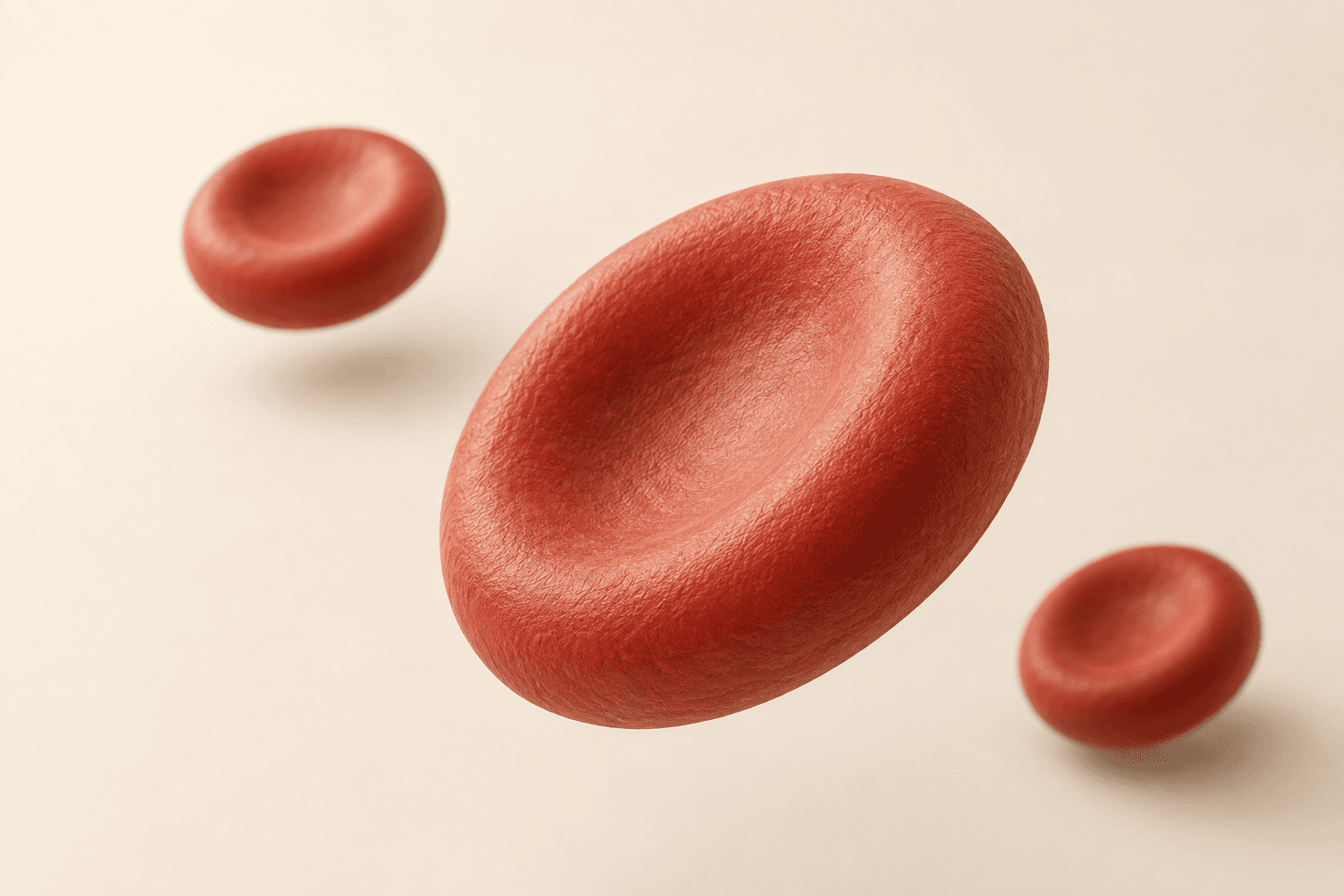
Start with the cell.
Red blood cells contain hemoglobin, the protein that carries oxygen from the lungs to tissues.
Next, look at one of the hemoglobin molecules inside a cell.
NIH · Iron ↗Illustrative cell shape. The next view uses a different scale.
A cell. A protein.
An iron-containing group.
Read the same explanation here, with or without the interactive model.
The red blood cell
Red blood cells contain hemoglobin, the protein that carries oxygen from the lungs to tissues.
NIH · Iron ↗Hemoglobin
Hemoglobin has four protein chains. Each holds a heme group containing an iron atom.
RCSB PDB-101 · Hemoglobin ↗Heme & iron
Oxygen can bind reversibly to the iron in heme. This is part of how hemoglobin carries and releases oxygen.
RCSB PDB-101 · Hemoglobin ↗A model with a source.
The cell is an illustration. The protein and heme views use experimental coordinates from human deoxyhemoglobin, PDB 2HHB (Fermi and colleagues, 1984).
Protein chains are drawn as smoothed alpha-carbon traces. Other protein atoms, water and surrounding structures are omitted. Heme connections come from the structure file; bond orders are not shown. Views are enlarged separately, and colours identify parts rather than their natural appearance.
This explains a biological mechanism. It does not establish who needs an iron supplement or provide diagnosis or personalized medical advice.
Sources checked 5 September 2026 · Human editorial review pending.